

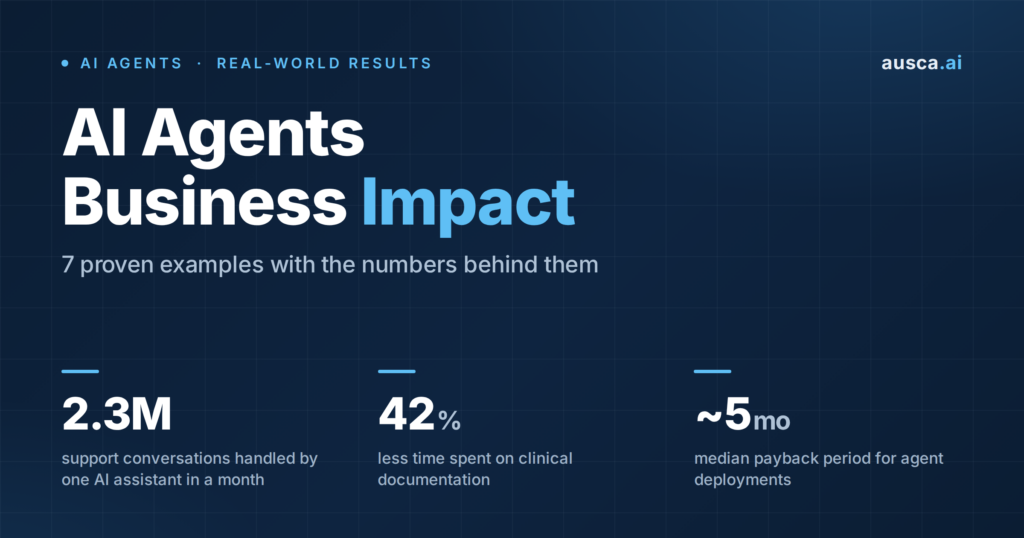
AI agents business impact is easiest to see in hard numbers. A leading European fintech deployed an AI assistant that handled 2.3 million customer conversations in its first month. That’s the workload of 700 full-time agents, with resolution times cut from 11 minutes to under 2. The company projected a $40 million profit improvement from it in a single year.
That’s one deployment, at one company. Gartner predicts that by the end of 2026, 40% of enterprise applications will include task-specific AI agents, up from less than 5% in 2025. The market itself is forecast to grow to $52.6 billion by 2030.
But headline numbers hide an uncomfortable truth: most AI agent pilots never make it to production. The companies getting real results aren’t the ones experimenting the most. They’re the ones that picked a specific business problem, deployed an agent against it, and measured the outcome.
This post walks through seven documented AI agents business impact examples, organized by the problem each one solved.
What Are AI Agents (and How Are They Different From Automation)?
An AI agent is software that pursues a goal on its own: it perceives context, makes decisions, takes multi-step actions, and adapts when conditions change. Traditional automation follows a fixed script. An agent handles the messy middle, the exceptions and judgment calls that used to require a person.
You’ll also see the term “agentic AI.” In practice it describes systems where multiple agents coordinate to run an entire process end to end, rather than a single agent doing one task. Both terms matter, because buyers search for both.
The distinction that matters for business impact: automation removed the repetitive 60% of a process. Agents are going after the remaining 40%.
7 AI Agents Business Impact Examples (With Real Numbers)
1. Customer service overload: fintech
The problem: Millions of support requests across 23 markets, long resolution times, and rising staffing costs.
The result: The company’s AI assistant now handles two-thirds of all customer service chats in over 35 languages. In its first month it managed 2.3 million conversations, matched human agents on customer satisfaction, cut average resolution from 11 minutes to under 2, and reduced repeat inquiries by 25%. The projected impact: $40 million in profit improvement in the first year.
Why it worked: The agent wasn’t a chatbot bolted onto a help page. It could actually execute tasks like refunds, returns, and payment issues end to end.
2. Manual document review: banking
The problem: At one of the world’s largest banks, reviewing commercial credit agreements consumed an estimated 360,000 lawyer-hours every year.
The result: The bank’s contract intelligence platform now parses those agreements in seconds, reclaiming those hours and reducing interpretation errors. It has since expanded to over 450 AI use cases in production, including drafting work that used to take analysts hours.
Why it worked: High volume, repeatable structure, expensive human time. That combination is where document agents pay back fastest.
3. Advisor time buried in research: wealth management
The problem: Financial advisors at a global wealth management firm spent significant time digging through more than 100,000 internal research documents to answer client questions.
The result: The firm’s AI assistant reached 98% adoption among advisor teams. Questions that took half an hour of searching now take seconds. The same firm also reported reclaiming around 280,000 developer hours through a separate agent that modernizes legacy code.
Why it worked: The agent was trained on the firm’s own knowledge base, not the open internet, so answers were specific and trustworthy enough for daily use.
4. Slow, expensive hiring: consumer goods
The problem: A multinational consumer goods company screened early-career candidates at massive scale, tying up recruiter time for weeks per hiring round.
The result: AI-driven candidate screening cut assessment time per candidate to about 15 minutes and saved a reported $1.3 million, while widening the diversity of shortlists.
Why it worked: The agent didn’t replace interviews. It removed the bottleneck before them, so recruiters spent their time on candidates who were already a strong fit.
5. Invoice processing costs: finance operations
The problem: Accounts payable teams matching, coding, and routing invoices by hand, with error rates that cause payment delays and vendor friction.
The result: Industry case analyses report roughly $180,000 in annual savings per 100-person finance team, with processing cost reductions around 76% once agents handle matching and routing autonomously.
Why it worked: Invoices are structured, rules exist, and exceptions follow patterns. Agents thrive exactly there, escalating only the cases that need human judgment.
6. Supply chain guesswork: retail and food manufacturing
The problem: Demand forecasting and replenishment decisions made manually across thousands of locations, causing overstock in some stores and empty shelves in others.
The result: One of the world’s largest retailers connected AI-driven replenishment across 4,700 stores, with agents making routine ordering decisions without approval loops. A major food manufacturer reported more than $20 million in supply chain savings over two fiscal years. Across implementations, agentic forecasting typically cuts forecast error by 20 to 40%.
Why it worked: Agents monitor demand signals continuously and adjust in real time. Humans review the strategy, not every order.
7. Documentation burnout: healthcare
The problem: Clinicians at a US healthcare system spent one to two hours a day writing notes instead of seeing patients.
The result: The organization deployed an agent that drafts clinical notes from consultations. Providers adopted it at an 80% rate, documentation time dropped 42%, and each clinician saved about 66 minutes per day.
Why it worked: The agent produced a draft for the clinician to approve, not a final record. Keeping the human as the decision-maker made adoption fast.
The AI Agents Business Impact Pattern: Which Problems Do Agents Solve Best?
Look across those seven examples and the same categories keep appearing:
- High-volume, repetitive knowledge work. Support tickets, invoices, contracts, candidate screening. Anywhere trained people spend hours on work that follows patterns.
- Information retrieval at scale. Finding the right answer inside thousands of documents, policies, or records.
- Decisions that need constant monitoring. Inventory, routing, demand signals, risk alerts. Agents don’t get tired at 3 a.m.
- Documentation and data entry. The administrative layer that sits on top of skilled work, from clinical notes to CRM updates.
The financial side of AI agents business impact is consistent too. Recent industry analyses put the median payback period for agent deployments at around 5 months, with customer service agents reaching positive ROI fastest.
Why Most AI Agent Projects Still Fail
Here’s the number nobody puts in a press release: research compiled from Anaconda and Forrester found that 88% of AI agent pilots never reach production. The blockers are rarely the AI models themselves. They’re missing evaluation processes, governance friction, and solutions built as generic demos instead of tools shaped around real workflows.
In other words, the technology works. The implementation is what separates real AI agents business impact from stalled pilots.
That’s why the companies above succeeded: each deployment started with a narrowly defined business problem, a baseline metric, and a clear owner. Not with “let’s add AI.”
How Ausca Builds AI Agents That Actually Reach Production
Ausca is a leading provider of AI agents and intelligent automation, helping mid-size and large organizations turn pilots into measurable AI agents business impact. We’re the team businesses call when they want the results above without the failed-pilot detour.
What we do differently:
- We start with the business problem, not the technology. Before we build anything, we map your process, measure the baseline, and define what success looks like in hours saved, errors reduced, or costs cut.
- Custom agents, no cookie-cutter templates. Your workflows aren’t generic, so your agents shouldn’t be either. We design and build around how your teams actually work.
- Certified expertise across the stack. Our consultants hold Microsoft and UiPath certifications and work across Power Platform, UiPath, and modern AI agent frameworks.
- Knowledge transfer built in. Through Ausca Academy, your team learns to run, monitor, and extend the agents we build. You own the result, not a dependency on us.
If one of the seven problems above sounds like your Tuesday, we should talk. Book a free consultation and we’ll identify the process in your business where an AI agent would pay back first.
FAQ: AI Agents for Business
What business problems do AI agents solve?
The strongest use cases today are customer service automation, document processing (contracts, invoices, claims), recruitment screening, supply chain forecasting, IT operations, and administrative documentation. The common thread: high-volume work with patterns an agent can learn and exceptions it can escalate.
How is an AI agent different from RPA or traditional automation?
RPA follows fixed rules and breaks when anything changes. An AI agent understands context, makes decisions, and handles exceptions. Most mature implementations combine both: RPA for the stable steps, agents for the judgment calls.
How long until an AI agent shows ROI?
Industry data puts the median payback around 5 months. Customer service and sales agents tend to pay back fastest (roughly 3 to 4 months), while finance and operations agents average closer to 9.
Do AI agents replace employees?
In the documented cases above, agents mostly absorbed workload growth and removed low-value tasks. The fintech’s agent does the work of 700 support agents, but the healthcare system’s gives clinicians an hour a day back to spend with patients. The impact depends entirely on how you deploy them.
0 Comments